Background
The first program to be executed looked for the highest factor of one number.
On 21st June 1948 they were using very small numbers like 19 in the morning, and 3142 in the afternoon. The reliability had
to be improved before they could run the 2^18 number taking 53 minutes. After this date, the experimental machine was expanded upon and led to the development of the
Manchester Mark 1 and later the Ferranti computers. In preparation for the 50th anniversary of the first program's
execution, a replica of the original machine was built at Manchester by a team lead by Christopher Burton a member
of the Manchester Computer Conservation Society. Christopher was of great help in advising on matters of historical
accuracy for this simulator of the Baby.
The replica of the Baby can be seen on display at the Museum of Science and Industry at Manchester and on certain
days of the week can be seen in operation. The team were kind enough to give me a guided tour on my trip to Manchester in April 2014 and I was able to finally try out the real thing.
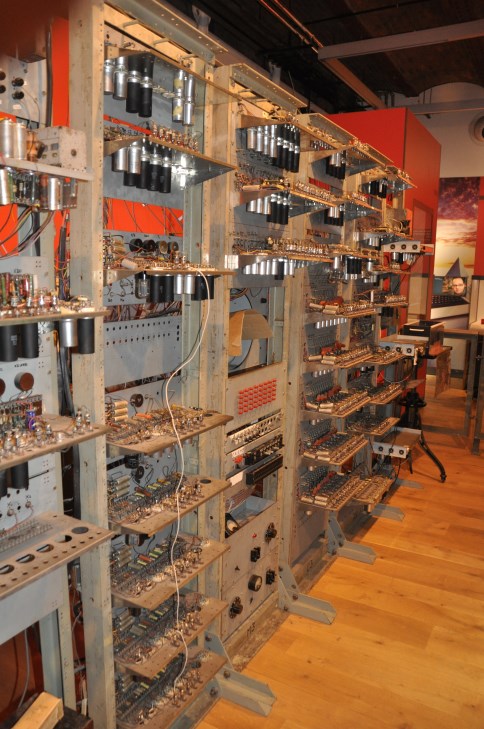
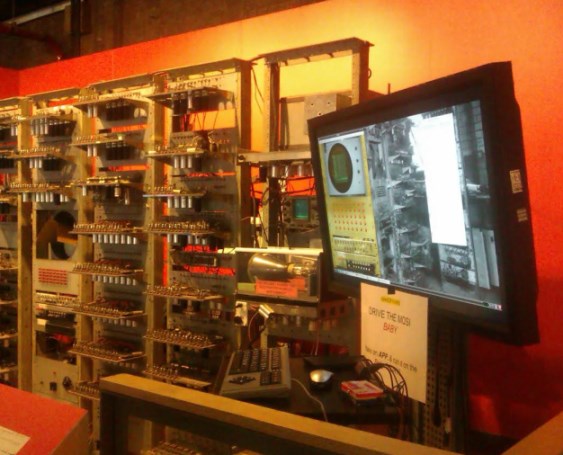
The front of the Baby replica, April 2014
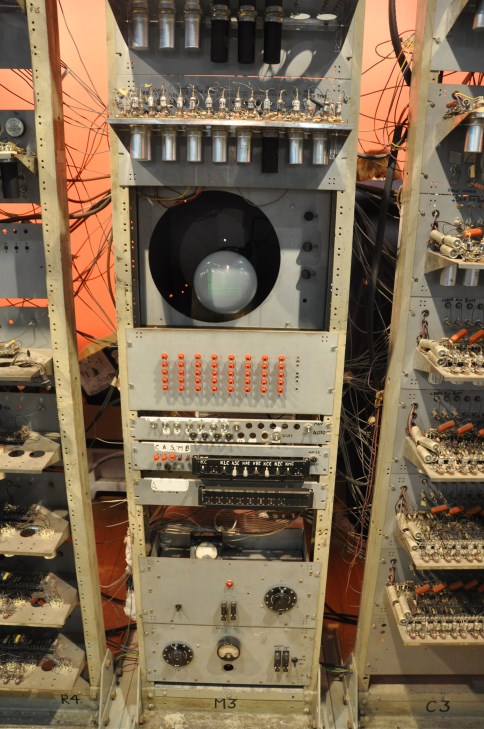
The front of the Baby replica's control panel and screen, April 2014
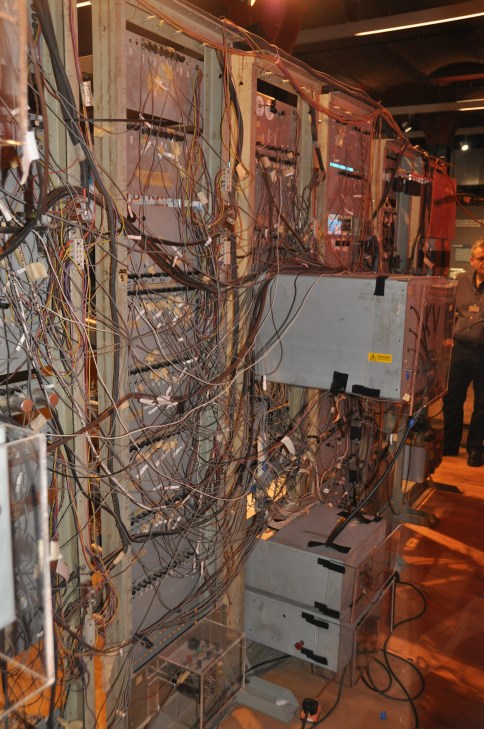
A rare glimpse at the rear of the Baby replica, April 2014
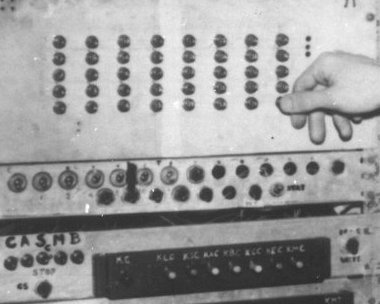
The Baby's switch panel, taken in December 1948
The Simulator running on a Raspberry Pi next to the Replica Baby at the MOSI Maker Faire 2014
Simulation
Unlike most other simulators that exist (including one I developed previously for
RISC OS) this attempts to accurately simulate the switch panels that were used to laboriously program the machine
along with many of the idiosyncracies that would have resulted from its incorrect use. The
volunteers at MOSI use the simulator is to help them practice using the replica and in
planning tests for the replica when it requires repair. The simulator is on display in the museum for the days when the
replica isn't in operation.
The simulator was updated by Gulzaman Khan, an undergraduate student at the University of Manchester for the 60th
Anniversary celebrations in 2008. The updated simulator was used for a competition for the public to write programs for the
baby as part of the celebrations (ironic given I first became aware of the machine as a result of reading about a similar
competition for the 50th anniversary).
Gulzaman's update means that the GUI is now a photo-realistic representation of the replica machine and can run as
a java applet or can be downloaded and run as an application. I've
had to move the applet off to another page due to the numerous security warnings that most browsers and java itself
throw up because the applet isn't signed.
 The original version is written in java
and requires a JVM supporting Java 1.2 or later to be installed and is still available to download. Full source code is included,
as is a detailed user
guide and an indepth discussion of the historical accuracy of the simulator. The simulator was written for the History
of Computing course as part of my BSc in Computer Science at the University of
Warwick.
The original version is written in java
and requires a JVM supporting Java 1.2 or later to be installed and is still available to download. Full source code is included,
as is a detailed user
guide and an indepth discussion of the historical accuracy of the simulator. The simulator was written for the History
of Computing course as part of my BSc in Computer Science at the University of
Warwick.
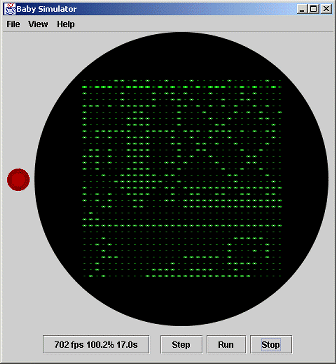
The simulator's tube - old plain-GUI simulator
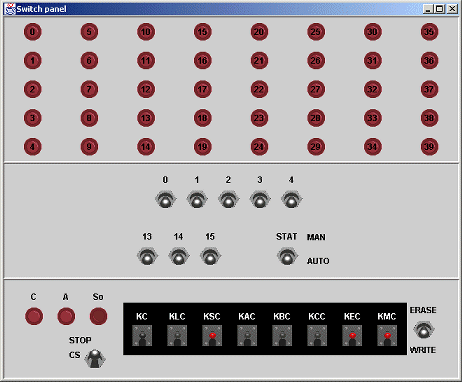
The simulators's switch panel - old plain-GUI simulator
Links
Digital 60 simulator with full user guide
Alan Burlison's blog about visiting the replica - Alan helped with some improvements to the source code
before Gulzaman's update.
BBC Manchester article Mar 2008 - about the 60th Anniversary celebrations and the simulator.
PC Plus article Jan 2010 - about the Manchester Baby and how to use this simulator.
 The Manchester Small Scale Experimental Machine (nicknamed the Baby) was built at the University of Manchester
shortly after the Second World War. Heavily influenced by the ideas of John Von Neumann and company at the Moore
School, Freddie Williams, Tom Kilburn and Geoff Tootill built the first operational stored program computer. This
was a massive step in the development of the computer allowing programs to be executed from an electrical rather
than an electro-mechanical store with the order of magnitude increase in speed that this brings. The machine was
built primarily to test out the use of tubes as a storage device and is the first use of the Williams Tube as it
later became known.
The Manchester Small Scale Experimental Machine (nicknamed the Baby) was built at the University of Manchester
shortly after the Second World War. Heavily influenced by the ideas of John Von Neumann and company at the Moore
School, Freddie Williams, Tom Kilburn and Geoff Tootill built the first operational stored program computer. This
was a massive step in the development of the computer allowing programs to be executed from an electrical rather
than an electro-mechanical store with the order of magnitude increase in speed that this brings. The machine was
built primarily to test out the use of tubes as a storage device and is the first use of the Williams Tube as it
later became known.
 184 Kb PDF File
 1.59 Mb Zip Archive